
Floor Preparation
Water Tight
- The building must be made be weather tight - the roof and external doors /window openings must be fitted with either final fixtures or clear polythene.
Exposed Edges
- Install temporary formwork to exposed edges (eg door openings or level changes)
Clean
- Remove all dust, debris and contamination from the floor surface.
Insulation:
- Ensure that all high/low points are removed from the sub-base and that insulation boards are laid flat.
- Insulation boards should be tightly butt jointed with staggered joints.
Membrane:
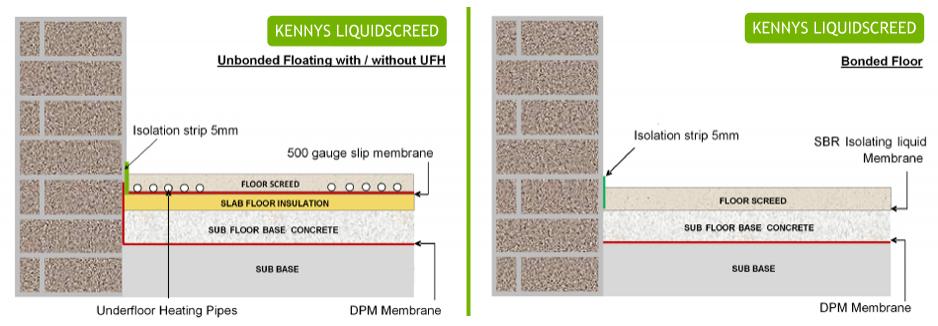
- Install a polythene separating membrane to floor (500 guage or similar) join with 50mm tape. Ensuring that all air pockets are removed and are free from punctures and creases.
- Lap joints should be 100mm and where necessary continue the polythene up the face of all wall/floor joints to the full depth of the screed.
- Perimeter isolation strip should be fixed at wall/floor junctions and around any columns, pipework etc
Underfloor Heating
- When used on underfloor heating we recommend using polythene to separate the membrane.
- All heating pipes and cables must be securely fixed down.
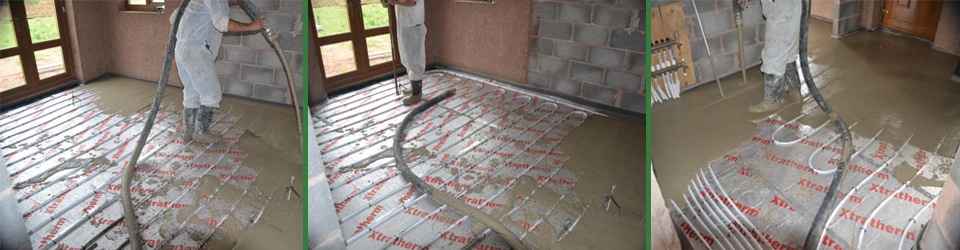
- Warm water systems should be filled prior to the application of to reduce the risk of pipes floating when the screed is poured.
Minimum Application Thickness:
- Bonded, 25mm
- Unbonded, 30mm
- Floating commercial, 40mm
- Floating domestic , 35mm
- Underfloor heating (min cover to pipe), 30mm
Please make an allowance for tolerances and any isolated high spots as this will impact on the overall depth and material usage.